Georgia Becomes First Universal Pre-K State to Meet All Ten of NIEER’s Preschool Quality Benchmarks

Georgia’s Lottery-funded Pre-K program for four-year-olds has made history. In a press conference held today at the Georgia Capitol, the National Institute for Early Education Research (NIEER) recognized the program for meeting all 10 of the organization’s research-based benchmarks for quality. These benchmarks measure essential preschool quality indicators, including teacher qualifications, class sizes, early learning standards, and program assessments.
According to NIEER’s 2025 State of Preschool Yearbook, Georgia Pre-K is the largest state-funded preschool program in the nation to meet all 10 quality benchmarks and the first universal program to do so.
“Other states should take note: Georgia proves that state-funded preschool with well-qualified teachers, pay parity with K-12, small classes, and strong continuous improvement systems can be scaled as a universal program,” says Steve Barnett, NIEER’s Director. “With new initiatives to support quality, Georgia can expect increased enrollment, but leaders should also actively promote increased enrollment.”
Passionate advocacy by GEEARS and our partners influenced the reforms that led to Georgia’s star status in this year’s Yearbook. Since our inception in 2010, we’ve championed Pre-K in meetings with governors and legislators. We’ve testified before committees and conducted research that has fortified the case for Pre-K as an essential source of early care and education, as well as a necessary driver of literacy in the K-12 years.
“In 2024, for instance,” recalls Hanah Goldberg, GEEARS’ Director of Research & Policy, “GEEARS testified before the House Working Group on Early Childhood Education, chaired by Speaker Pro Tempore Jan Jones. In the ensuing legislative session, almost $100 million was added to the state’s Pre-K Budget. This historic increase has funded pay parity for Pre-K teachers; the restoration of class sizes to 20 students/class; transportation support; and increased funds for classroom start-up grants, summer transition programs, and operation budgets. We’re incredibly proud of the role GEEARS and our partners have played in enhancing our state’s early education landscape, and we’re grateful to NIEER for amplifying Georgia’s accomplishment.”
NIEER notes that the two changes that gave Georgia Pre-K its perfect score in this year’s assessment were 1) improving its teacher-to-child ratio from 1:11 to 1:10 and 2) lowering maximum class sizes to 20.
While this year’s report featured five additional states that met all 10 of NIEER’s research-based benchmarks for quality —Alabama, Hawaii, Michigan, Mississippi, and Rhode Island—none of those programs have the reach of Georgia’s Pre-K, which serves more than half of the state’s four-year-olds annually.
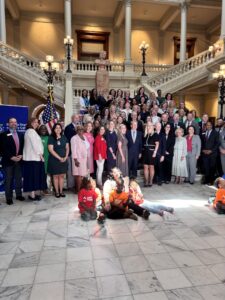
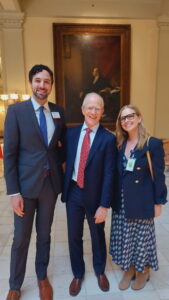
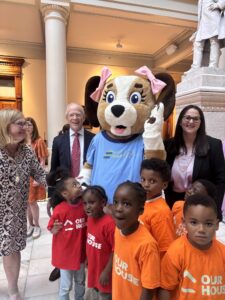
Georgia Governor Brian Kemp participated in the April 22nd press conference celebrating Georgia Pre-K’s historic achievement, along with representatives from the Georgia Department of Early Care and Learning and several child-serving nonprofits.
“We call the funding we put toward the Pre-K program an investment because the benefits don’t just show up immediately. We see them for literally generations afterwards,” Governor Kemp said. “That long-term and challenging work of raising the next generation of innovators, doctors, pilots, manufacturers, employers, and perhaps even legislators begins in our preschools. And like any good asset that grows across our state and brings so much economic benefit to our communities, students who attended Georgia Pre-K take years to fully grow and mature, but their success on the other side of that decades-long journey is certainly well worth the wait.”
Click here to see Georgia’s entry in the State of Preschool Yearbook, including maps, graphs, and state rankings.
The 2025 State of Preschool Yearbook was supported with funding from the Heising-Simons Foundation and the Gates Foundation.
The National Institute for Early Education Research at the Rutgers Graduate School of Education, New Brunswick, NJ, supports early childhood education policy and practice through independent, objective research and the translation of research to policy and practice.