Child Care Challenges and Their $2.5 Billion Economic Impact
By GEEARS for The Saporta Report
In 2018, GEEARS: Georgia Early Education Alliance for Ready Students and the Metro Atlanta Chamber conducted a study to better understand the prevalence, nature, and impact of child care challenges. The results revealed that such challenges had a devastating impact on families’ ability to participate in the workforce and their economic well-being. This hardship for families also affected employers and Georgia’s economy.
After a financially volatile seven years that included a global pandemic, skyrocketing costs of living, and widespread inflation, we decided to conduct an updated analysis. While our findings in 2018 were alarming, the results of our 2024 analysis are even more dire. By every metric, the effects of child care challenges on family finances, employers’ balance sheets, and our state’s economy have worsened.
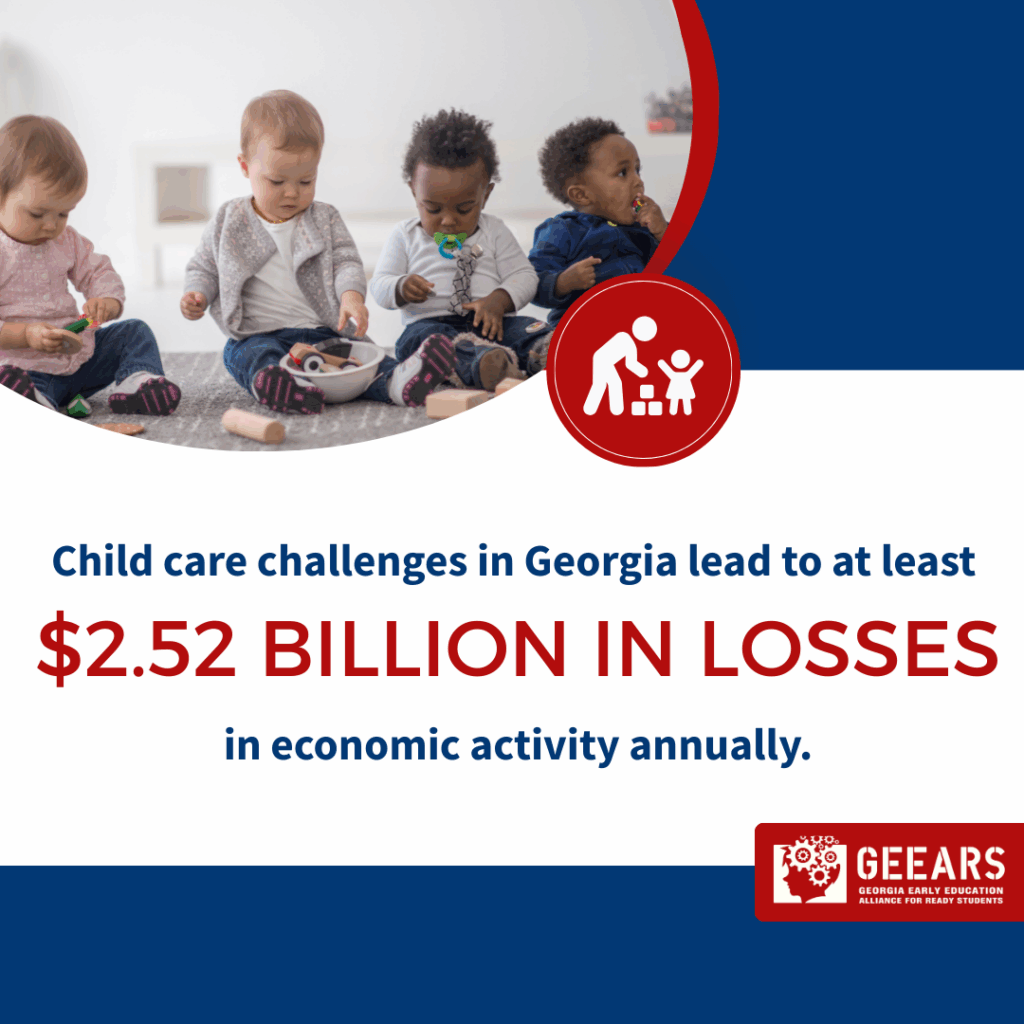
Child care challenges in our state currently lead to more than $2.5 billion in lost economic activity per year, an increase from $1.75 billion in losses in 2018. More than $131 million is also lost in tax revenue for the state. Again, this figure is greater than 2018’s $105 million.
The biggest child care issue families face is often cost. According to our study, the average amount parents spend monthly on child care has increased by a whopping 77% since 2018, representing a greater portion of families’ overall budget.
“One of the biggest challenges that I face right now is finding affordable child care,” a Stone Mountain mother told us. “Sadly, in my area there are not many places that will accept a three-year-old that is reasonable. I had to make the decision to stay home.”
Another mom from Atlanta said, “I wasn’t able to continue working in my career because full-time child care is expensive and would have left me with not much take-home pay.”
Across the board, these challenges have led to more employment disruption for parents in 2024 than in 2018. For example, 31% of our surveyed parents quit a job, school, or work training in 2024 due to child care challenges, vs. 21% in 2018. Thirty-four percent changed from full-time to part-time employment in ‘24 vs. 18% in ‘18, and 30% turned down the chance to move from part-time to full time employment vs. 21%. In 2024, 13% of those surveyed were fired due to child care difficulties, vs. 5% in 2018 and 26% turned down a promotion, an increase from 18% in 2018.
As some parents leave or curtail their hours in the workforce, others are resorting to changing their plans for their families. Fifty-three percent of the Georgians in our study have delayed or decided not to have more children as a result of child care costs.
“My husband and I are thinking of having a second child, but we couldn’t afford to have two children in care at our current center or many of the centers near us,” a Chamblee mother told us. “I would like to stay in the workforce, but it would be a huge strain financially.”
What’s difficult for families is, of course, also detrimental to employers. This is one reason the Metro Atlanta Chamber joined GEEARS in conducting this research.
“Revisiting the economic impact study with GEEARS has been a critical milestone,” said Tim Cairl, Vice President of Talent Development at MAC. “The findings clearly show that inadequate support for families with young children directly affects both businesses and the broader economy.”
At a press conference about this study, John Jackson, a father and Atlanta Head of Finance and Strategy at BlackRock, said, “If businesses don’t support their employees’ need for family-friendly policies like paid leave and child care supports, they will lose out when it comes to productivity, retention, and the ability to attract new hires in a competitive market. They’ll also lose a vital chance to cultivate the future workforce—the adults these little kids are going to be in just a few short years.”
One of those little kids is Noah, the son of Decatur mom, Charnel Ferba.
“As a single mother, I’m doing everything I can to give Noah the best possible launch in life,” Ferba said when she spoke at the press conference. “For me, that means giving him stability—a slot in a preschool where he can learn and socialize with other toddlers while his mom earns a living wage. Despite my best efforts, Noah and I don’t have either of those things right now. Meanwhile, every day that Noah doesn’t have access to early learning is a missed opportunity for him.”
Child care challenges could mean missed opportunities for all Georgians: Parents who aren’t able to thrive in the workforce; state and local economies that lose billions each year; and businesses that incur expenses and disruptions when employees find themselves in child care binds.
Georgia’s policymakers can move the needle for the state’s families and bolster the economy by championing policies and programs that expand paid leave, tax credits, child care scholarships, Georgia’s Pre-K, and more.
The business community can also be part of the solution by implementing family-friendly policies to support their employees who are parents or caretakers. They can offer paid family leave, flexible work hours, work-at-home policies, and/or time off to volunteer at their children’s schools. Most critically, they can offer on-site child care or subsidize their employees’ child care expenses. As Jackson noted, such investments are essential for our workforce, both present and future.
Employers who are already utilizing family-friendly practices can receive recognition by filling out a brief form at Best Place for Working Parents ® Georgia. Perhaps even more important, Best Place is a resource where employers can learn about family-friendly practices—the options, how to deploy them, and their proven contribution to business success. Such commitments, along with a greater public investment in child care, are essential steps toward helping families afford the very pricy project of raising young children while contributing to the workforce, their communities, and Georgia’s economy.